


Financial ratios are a great way to show the health of an organization relative to its peers. Its often represented as a relationship between two line items on a financial statement. Value Investors often look at these financial ratios using screeners as a buy or sell signal. A simple understanding of each financial statement (Income Statement, Balance Sheet, and Cash Flow) can help you then apply that data in calculating the Financial Ratios.
Where Financial Ratios Come From
The Financial Ratios primarily come from the three financial statements:
- Income Statement: Used to represent the revenue and costs an organization may face. Factors in activities like tax, goodwill, and appreciation/depreciation. :See Income Statement Basics for more information.
- Balance Sheet: Used to represent the organizations current Equity relative to Assets and Liabilities. See Balance Sheet Basics for more information.
- Cash Flow: Use to represent the various cash transactions across an organization. Most clear representation of the actual health of the company when using GAAP standards. See Cash Flow Basics for more information.
;All of these ratios will be pulled from one of these three statements.
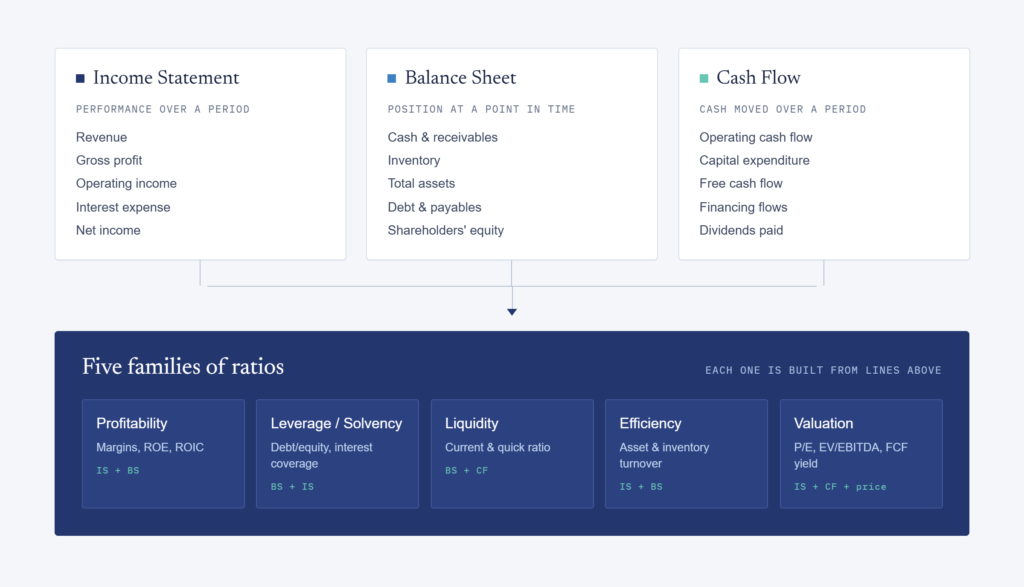
Five Categories of Financial Ratios
Each type of ratio (Profitability, Leverage, Liquidity, Efficiency, and Valuation) tell there own unique story. Not a single ratio tells you if an investment will be successful, but often the combination of ratios may help improve your odds of success.
Profitability Ratios
These Profitability Ratios tell you about how much revenue and organization is receiving relative to their costs.
- Gross Profit Margin
- Operating Margin
- Net Margin
- Return on Capital Employed (ROCE)
- Return on Equity (ROE)
Leverage Ratios
These Leverage Ratios tell you you how much debt the organization has relative to their value.
- Debt-To-Equity
- Financial Leverage Ratio
- Interest Coverage Ratio
Liquidity Ratios
These Liquidity Ratios tell you how well an organization is positioned to pay interest on their debt obligations.
- Current Ratio
- Quick Ratio
- Cash Ratio
Efficiency Ratios
These Efficiency Ratios tell you how well an organization is operating as a business.
- Cash Conversion Ratio
- Inventory Turnover
- Receivables Turnover
- Asset Turnover
Valuation Ratios
These Valuation Ratios tell you how much the current price of the stock is relative to their worth.
- Price-To-Earning (P/E)
- Price-To-Book (P/B)
- Enterprise Value-to-EBIDTA (EV/EBIDTA)
- Price-Earnings-Growth (PEG)
- Free Cash Flow Yield
Using Financial Ratios in Practice
Financial Ratios are a great way to screen for a financially healthy organization that you want to invest in long term. Using these Financial Ratios is not a one-time activity, rather, something you should continue to do over time as new financial statements get released, or as the direction of the business starts to change.
For calculating the Financial Ratios for the companies you want to invest in, confirm if your brokerage account provides that information, or you could go to: https://www.sec.gov/search-filings